Why Visual Differentiation Is Crucial in 2024-2025
The coloring book market has experienced a genuine revolution with the arrival of AI tools like Color In AI. However, this democratization has also created a significant challenge: visual saturation.
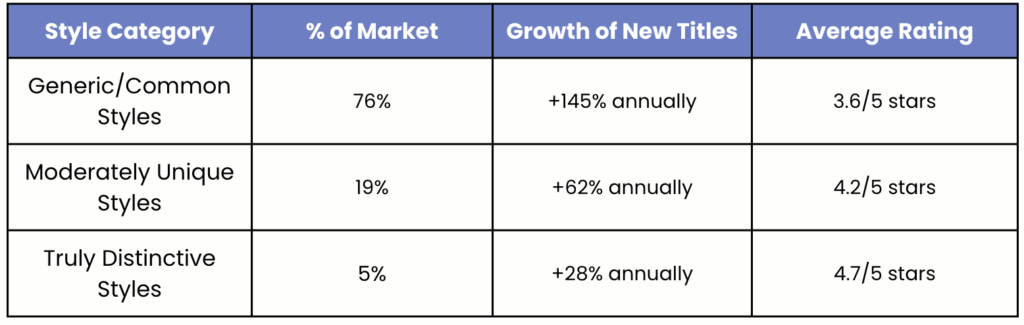
A recent analysis of the 10,000 best-selling coloring books on Amazon KDP reveals an alarming pattern:
«In 2024, more than 60% of coloring books on major platforms use visual styles that are almost indistinguishable from each other, creating ‘visual fatigue’ in consumers that makes it increasingly difficult to stand out with generic content.» – Digital Market Trends Study, 2024
The data reveals a fascinating paradox: while generic styles dominate in volume, distinctive styles generate:
- Average prices 43-78% higher
- Conversion rates 2.3 times higher
- Significantly better ratings
- Greater brand loyalty and repeat purchases
This gap represents a strategic opportunity for entrepreneurs willing to invest in visual differentiation.
The Generic vs. Distinctive AI Dilemma
Most users of AI tools make the same mistake: they use generic prompts that generate predictable results and that’s why it is so important to learn how to use AI to create coloring books with unique designs.
Typical generic prompts:
- «Intricate mandala for coloring»
- «Beautiful flowers for coloring book»
- «Cute animal with line style»
These prompts produce technically correct but aesthetically indistinguishable designs from thousands of others available in the market.
The key to success lies in understanding that AI tools like Color In AI are not simple image generators, but sophisticated systems capable of creating unique styles when given precise and strategic instructions.
The Master Method: How to Generate Truly Unique Designs
The most successful creators in the market follow a systematic 5-step method to develop distinctive visual styles:
1. Research Unexplored Visual Territory
Before generating a single design, these entrepreneurs conduct thorough research:
Strategic research process:
- Analysis of the 30-50 best-selling books in their niche
- Identification of common visual patterns
- Mapping of unexplored or underexploited «visual territories»
- Search for artistic references outside the coloring book field
Recommended tools:
- Pinterest to create boards of «what I DON’T want to do»
- Amazon Look Inside to analyze competition
- Collections of thematic art as differentiating inspiration
2. Development of Unique Stylistic Concept
Based on research, they create a distinctive «stylistic concept» by combining elements in a structured way:
Stylistic concept formula: [Unusual artistic style] + [Main thematic element] + [Differentiating twist] + [Technical restriction]
Effective examples:
- «Japanese Art Nouveau with fractal elements and exclusively curved lines»
- «Geometric cubism applied to animals with repetitive patterns and exclusive use of hexagonal shapes»
- «Victorian engraving style with botanical motifs in radial composition and restriction to variable-thickness lines»
What to avoid:
- Concepts that are too broad («nice style»)
- Extremely popular styles without modification («mandala style»)
- Combining too many elements without coherence
3. Creation of Strategic Prompt Bank
With the concept defined, they develop a systematic set of prompts that maintain coherence:
Master prompt structure: [Specific subject] in style [detailed stylistic concept], [technical specifications], [restrictions], [artistic references], optimized for coloring book with clear lines
Real example of master prompt: «Detailed Tudor rose in Victorian botanical engraving style with Ernst Haeckel influence, centered composition, sharp black lines on white background, medium-high detail density, no shading, no areas too small to color, visual balance with well-defined spaces for coloring»
Iteration strategy:
- Keep 70-80% of the prompt constant for stylistic coherence
- Vary 20-30% for diversity within the same style
- Document successful variations to replicate them
4. Technical Refinement for Colorability
What distinguishes the best creators is their focus on the coloring experience, not just aesthetics:
Critical colorability parameters:
- Optimal detail density: Enough for visual interest, not so many that they frustrate
- Strategic negative space: Areas for visual breathing and self-expression
- Consistent line thickness: Adapted to different coloring tools
- Contrast and definition: Clear boundaries between colorable areas
- Graduated complexity: Variation for different skill levels
Optimization process:
- Generate initial design
- Evaluate with colorability checklist
- Refine prompt with specific adjustments
- Regenerate until optimal balance is achieved
- Test by manually coloring key sections
5. Quality Control and Coherence System
Successful creators implement a rigorous selection system:
Typical production-selection ratio:
- For every 100 images generated, they select 25-30 for detailed evaluation
- Of those, only 15-20 make it to the final product
- The best 5-8 are highlighted as promotional images
Selection criteria:
- Adherence to the defined stylistic concept
- Visual uniqueness compared to competition
- Balance between detail and spaces for coloring
- Overall aesthetic appeal
- Coherence with other selected images
This systematic process allows for creating a collection of images that are individually attractive and collectively coherent, creating a distinctive and recognizable visual experience.
7 Differentiating Styles with High Commercial Potential
Based on trend analysis and emerging niches, these styles show an excellent balance between commercial appeal and low saturation:
1. Neo-Victorian Botanical Style
Description: Detailed plant illustrations inspired by Victorian botanical catalogs but with contemporary elements.
Effective base prompt: Detailed botanical illustration of [specific plant] in Victorian catalog style with Ernst Haeckel influence, sharp black lines on white background, centered and symmetrical composition, precise anatomical details, old engraving style with parallel line textures, optimized for coloring book with well-defined areas for coloring.
Why it works: Combines the nostalgia and elegance of Victorian art with contemporary interest in botany and nature.
Commercial potential: Niches in gardening, herbalism, biology, and naturalistic decoration.
2. Isometric Fantastic Architecture
Description: Imaginary architectural structures presented in isometric perspective with detailed levels.
Effective base prompt: Fantastic [specific theme: floating/underground/steampunk] city in detailed isometric perspective, technical architectural line style, influenced by M.C. Escher and Italo Calvino’s imaginary cities, only black lines on white background, multiple interconnected levels and structures, no shading, optimized for coloring book with varied spaces.
Why it works: Offers both visual satisfaction and intellectual challenge, with endless areas to discover and color.
Commercial potential: Puzzle lovers, architecture, fantasy, and design enthusiasts.
3. Stylized Cultural Fusion
Description: Deliberate combination of two culturally distinct artistic traditions.
Effective base prompt: [Traditional subject] presented as a fusion of [culture 1] and [culture 2] art, for example: «Samurai presented as a fusion of Japanese ukiyo-e style with French Art Nouveau decorative elements», clean and flowing lines, detailed ornamental patterns, no shading, defined spaces for coloring, balanced composition.
Why it works: Creates something visually unique that feels familiar yet surprising, generating interest in multiple cultural markets.
Commercial potential: World art followers, art history students, multicultural communities.
4. Organic Micro-Macrocosm
Description: Designs that play with scale, revealing similar patterns at different levels of nature.
Effective base prompt: Composition showing [large natural element: galaxy/landscape/ocean] that seamlessly transitions to [microscopic element: cell/molecule/microorganism] with continuous fractal patterns, detailed scientific line style, inspired by «Powers of Ten» illustrations, only defined black lines, areas of variable complexity for different coloring levels.
Why it works: Combines science and art in a visually impactful and educational way.
Commercial potential: Educators, science enthusiasts, educational market for all ages.
5. Sequential Visual Narrative
Description: Series of illustrations that tell a continuous story through the pages.
Effective base prompt: Scene [number] of a narrative sequence about [theme/story], showing [specific action], clear line illustration style similar to Franco-Belgian comics, dynamic composition, visual continuity with previous and next scenes, defined black lines, clear spaces for coloring, recognizable elements that repeat throughout the narrative.
Why it works: Creates greater engagement by incentivizing completion of the series and discovering the complete story.
Commercial potential: Storytellers, educators, therapists who use narratives, families.
6. Contemporary Sacred Geometry
Description: Precise mathematical patterns inspired by sacred geometry but with modern interpretation.
Effective base prompt: Sacred geometry pattern based on [shape/concept: flower of life/Metatron’s cube/golden spiral] reinterpreted with [contemporary/natural/technological] elements, mathematical precision in lines, [radial/bilateral/fractal] symmetry, gradual complexity from center outward, sharp lines of consistent thickness, optimized for meditative coloring experience.
Why it works: Combines spirituality, mathematics, and visual art in hypnotic and satisfying designs.
Commercial potential: Meditation, mindfulness, recreational mathematics, and therapeutic art markets.
7. Fantastic Hybrid Metamorphosis
Description: Subjects that gradually transform into other elements, creating surreal compositions.
Effective base prompt: [Main subject] gradually transforming into [different element] through detailed metamorphosis, surrealistic scientific illustration style inspired by Dalí and Ernst, fluid transitions between elements, precise black lines on white, anatomically detailed and believable transformation within the fantastic, areas of variable detail, optimized for coloring.
Why it works: Creates visually fascinating images that invite personal interpretation and exploration.
Commercial potential: Creatives, dreamers, people interested in psychology, surrealist art fans.
Advanced Prompt Engineering Strategies for Color In AI
The true art of creating unique designs with Color In AI lies in mastering prompt engineering at an advanced level. These techniques separate beginners from masters:
1. Conceptual Layer Technique
Rather than a monolithic prompt, structure by instruction layers:
LAYER 1 (Base concept): [Subject] + [Main artistic style] LAYER 2 (Stylistic modifiers): [Influences] + [Distinctive elements] LAYER 3 (Technical specifications): [Line requirements] + [Composition] LAYER 4 (Optimization): [Specific parameters for coloring] + [Restrictions]
Applied example: LAYER 1: Siberian tiger in Art Nouveau style LAYER 2: Influenced by Alphonse Mucha with organic decorative elements and integrated floral patterns LAYER 3: Fluid but defined black lines, variable thickness, composition that dynamically fills the space LAYER 4: Optimized for coloring book with well-defined areas, variation in space size, without areas too small or intricate to color
2. Creative Restriction Technique
Paradoxically, imposing specific restrictions generates more creative and distinctive results:
Effective prompt restrictions:
- Element limitation: «Using only circular shapes and curved lines»
- Structural restriction: «Composition based exclusively on the golden ratio»
- Technical limitation: «No parallel lines, only angular intersections»
- Conceptual consistency: «Each element must transform into the next»
Applied example: Mountain landscape in Japanese ukiyo-e style, using exclusively curved lines (no straight lines), asymmetrical composition following rule of thirds, each natural element must contain a hidden geometric pattern, optimized for coloring with contrast between detailed areas and open spaces
3. Multiple Artistic Anchoring Technique
Referencing specific combinations of artists/styles creates unique fusions:
Anchoring formula: Inspired by the [technique/element] of [Artist 1] + the [composition/theme] of [Artist 2] + the [palette/aesthetic] of [Artistic Movement]
Applied example: Owl illustration in a style that combines Albrecht Dürer’s line technique, William Morris’s decorative composition, and the symbolic aesthetic of Czech Art Nouveau, optimized for coloring book with defined black lines on white background
4. Calibrated Contrast Technique
Deliberately balancing opposite elements creates interesting visual tension:
Effective contrast pairs:
- Organic vs. Geometric
- Detailed vs. Minimalist
- Symmetrical vs. Asymmetrical
- Structured vs. Chaotic
- Microscopic vs. Cosmic
Applied example: Botanical design that contrasts perfect geometric elements (hexagons, circles, straight lines) with natural organic forms (petals, leaves, roots), creating visual tension between order and chaos, with variable but balanced detail density, optimized for coloring experience
5. Stylistic Evolution Technique
Develop a style through progressive iterations, refining with each generation:
3-phase process:
- Broad exploration: 10-15 variations with significantly different prompts
- Convergence: Select most promising elements and combine in 5-7 new prompts
- Refinement: Iterate with subtle adjustments until the distinctive style is perfected
Crucial documentation: Maintain a «prompt journal» recording each iteration and results to identify success patterns.
Building Visual Cohesion and Branding
The true differentiating value comes not from individual images but from coherent collections that build a recognizable visual identity:
1. Cohesion Element System
Successful entrepreneurs incorporate «visual anchors» that create recognition:
Effective cohesive elements:
- Recurring motif: An element that appears in all images (symbol, pattern)
- Compositional structure: Consistent format (circular, divided, framed)
- Stylistic feature: Distinctive treatment of certain aspect (texture, lines)
- Conceptual element: Underlying theme that connects all pieces
Applied example: Marta L.’s «Microscopic Cosmos» series includes a small spiral element in each design that serves as a visual signature, regardless of the specific theme.
2. Strategic Collection Architecture
Organize designs not randomly but as an interconnected visual system:
Effective collection structures:
- Progression: Gradual evolution from simple to complex
- Counterpoint: Deliberate alternation between complementary styles
- Visual narrative: Sequence that tells a visual story
- Unifying theme: Different representations of a central concept
Applied example: Carlos D.’s «Natural Metamorphosis» collection presents 30 designs organized in 5 series of 6 images, each series showing the gradual transformation of one natural element into another.
3. Integrated Visual Branding
Incorporate subtle brand elements within the designs themselves:
Integrated branding strategies:
- Visual signature integrated into the design (not added afterward)
- Compositional elements that form stylized initials or logo
- Distinctive repeated pattern that becomes a brand identifier
- Unique style of treating certain elements (like an author’s signature)
Applied example: The «Architectural Reveries» collection includes in each design a small architectural element that, when carefully observed, forms the creator’s initials, becoming their recognizable trademark.
Success Stories: Entrepreneurs Who Revolutionized the Market
Case 1: Marta L. – «Botanical Cosmology»
Marta started creating generic mandala books with moderate results (monthly sales of $650-800). After researching the market, she developed a unique concept:
Differentiating concept: «Fusion of 19th-century scientific botanical illustrations with astronomical and cosmic elements, where each plant partially transforms into a celestial body or cosmic phenomenon.»
Development process:
- Studied historical botanical illustrations and NASA astronomical art
- Created a bank of 50+ refined prompts after multiple iterations
- Developed a visual system where each plant «cosmifies» in a unique way
- Generated more than 300 images to select the final 45
- Organized the book as a «journey» from terrestrial plants toward the cosmos
Results:
- Price: $26.99 (vs. $12.99 for her previous books)
- Average monthly sales: $2,300+
- Average rating: 4.8/5 stars
- Notable comments: «Never seen anything like it» / «Immediately recognizable»
«The defining moment was when a customer wrote to me saying they had recognized my style on Pinterest without seeing my name. That’s when I knew I had created something truly distinctive.» – Marta L.
Case 2: Carlos D. – «Mechanical Anatomy»
Carlos had engineering training and was always fascinated by the intersection between organic and mechanical:
Differentiating concept: «Renaissance-style anatomical illustrations (like Da Vinci) where parts of human and animal bodies transform into detailed biomechanical machinery, maintaining anatomical precision.»
Development process:
- Studied historical anatomical drawings and mechanical designs
- Created a «visual language» where certain organs and systems are represented as specific machines
- Developed a prompt technique that generated «mechanical X-rays»
- Established a proportion of 70% anatomy / 30% mechanical to maintain recognition
- Implemented a progressive system of complexity throughout the book
Results:
- Expansion to a series of 3 books (Human, Animal, Mythological)
- Combined sales: $3,800+ monthly
- Additional opportunities: Commissions for book covers, collaboration with scientific publisher
«What began as an experiment became my distinctive style. Customers now specifically seek me out for this unique fusion of anatomy and mechanics, something that no one else was doing exactly this way.» – Carlos D.
Case 3: Elena R. – «Impossible Cities»
Elena experimented with fantastic architecture without finding a distinctive style until she developed:
Differentiating concept:
«Architecturally impossible cities inspired by Escher, Piranesi, and architectural surrealism, where each building defies the laws of physics while maintaining visual coherence and well-defined spaces for coloring.»
Development process:
- Mapping of underrepresented architectural styles in coloring books
- Study of impossible perspectives and visual paradoxes
- Creation of own «architectural grammar» with distinct elements
- Development of system to balance visual complexity with «colorability»
- Implementation of visual narrative where each city connects with the next
Results:
- Dedicated community with more than 2,800 members sharing colorations
- Expansion to additional merchandise (prints, t-shirts)
- Collaboration with board game to create special edition
- Monthly income: $4,200+ combined (book + derivative products)
«I discovered that true differentiation comes not just from technique but from the underlying concept. When you define a unique conceptual territory, visual differentiation flows naturally.» – Elena R.
Conclusion: Creating Your Visual Revolution
Differentiation through AI is not only possible but strategically essential in an increasingly saturated market. The common pattern among success stories reveals:
- Deliberate research before creation
- Clearly articulated differentiating concept
- Methodical system for developing the style
- Coherence and consistency throughout the collection
- Iterative refinement until perfection
With tools like Color In AI, the technical barrier has disappeared. The true competitive advantage now lies in creative vision, systematic process, and patience to develop a truly distinctive style.
Final reflection: In a world where anyone can generate images, the ability to generate images impossible to confuse with others becomes your most valuable asset.
Ready to develop your unique visual style? Try Color In AI for free and start creating truly distinctive designs today.